
Do You Need RAMS for Domestic Work?
Quick Answer
Not every domestic job requires a Risk Assessment and Method Statement (RAMS), but if the work involves significant risks—such as working at height, electrical installations, structural alterations or hazardous substances—creating RAMS is often a sensible way to plan the work safely and demonstrate professionalism.
Many contractors also choose to produce RAMS because clients or insurers may request them before work begins.
What Is a RAMS Document?
A RAMS document combines two essential health and safety documents:
Risk Assessment – Identifies the hazards associated with the work and explains how the risks will be controlled.
Method Statement – Describes how the work will be carried out safely, step by step.
Together, they help contractors plan work safely and provide confidence to clients that risks have been properly considered.
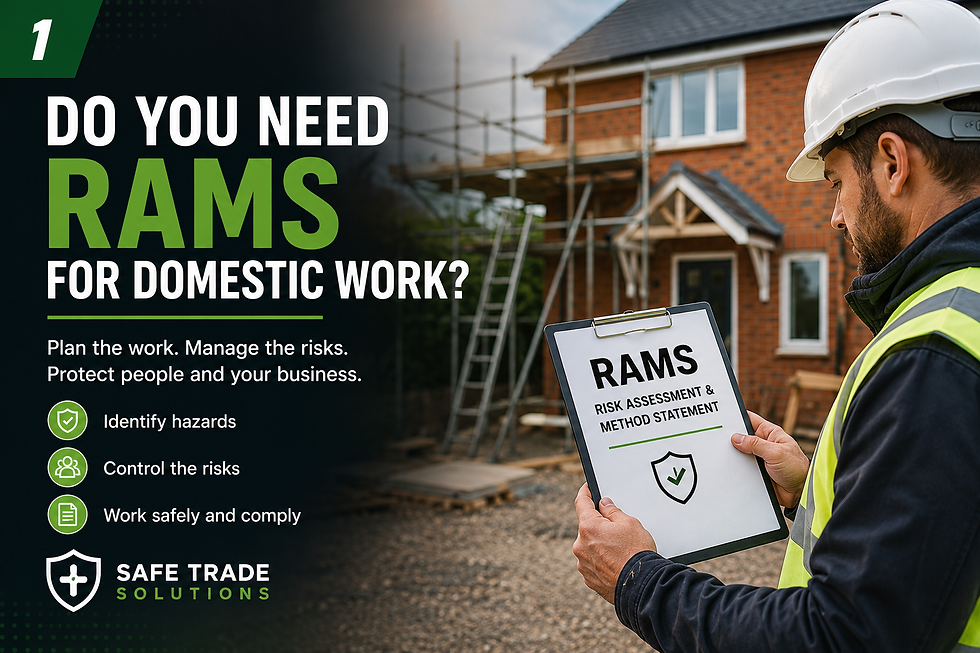
When Should You Create RAMS for Domestic Work?
Although there is no requirement for every domestic task to have formal RAMS, they're recommended whenever the work presents significant risks.
Examples include:
Roofing and chimney work
Consumer unit replacements
Structural wall removals
RSJ installations
Loft conversions
Excavations
Tree surgery
Working at height
Hot works
Work involving hazardous substances
The higher the risk, the more important it becomes to plan the work properly.

Why Contractors Still Use RAMS on Domestic Jobs
Even where RAMS aren't specifically requested, they provide several benefits.
They help you:
Identify hazards before work starts.
Demonstrate professionalism.
Protect homeowners and members of the public.
Plan safer working methods.
Reduce the likelihood of accidents.
Keep a record of how risks were managed.
For many contractors, they also make conversations with clients easier because they show that safety has been considered from the outset.
Do Small Domestic Jobs Need RAMS?
The level of documentation should always reflect the work being carried out.
A simple decorating job or replacing a tap washer is very different from replacing a roof or carrying out electrical work.
Rather than using the same documentation for every project, your assessment should always be proportionate to the risks involved.

Frequently Asked Questions
Do electricians need RAMS for domestic work?
For higher-risk electrical work or where requested by a client or principal contractor, producing RAMS is often appropriate.
Do roofers need RAMS?
Roofing involves working at height, making suitable planning and risk assessment particularly important.
Can homeowners ask for RAMS?
Yes. While more common on commercial projects, some domestic clients request RAMS before allowing work to begin.
Can sole traders create RAMS?
Absolutely. Sole traders frequently create RAMS to demonstrate safe planning and satisfy client requirements.
Create Bespoke RAMS in Minutes
Writing RAMS from scratch can take valuable time.
Safe Trade Solutions enables contractors to generate bespoke, editable Risk Assessments and Method Statements in minutes. Simply enter your job details and our AI-powered platform creates documentation tailored to your work.
Every document can be edited, branded with your company logo and downloaded instantly—helping you spend less time on paperwork and more time completing the job safely.
Start your 14-day free trial today – no payment details required.




Comments