
What Should a Risk Assessment Include? A UK Contractor's Guide
What Should a Risk Assessment Include? A UK Contractor's Guide
Quick Answer
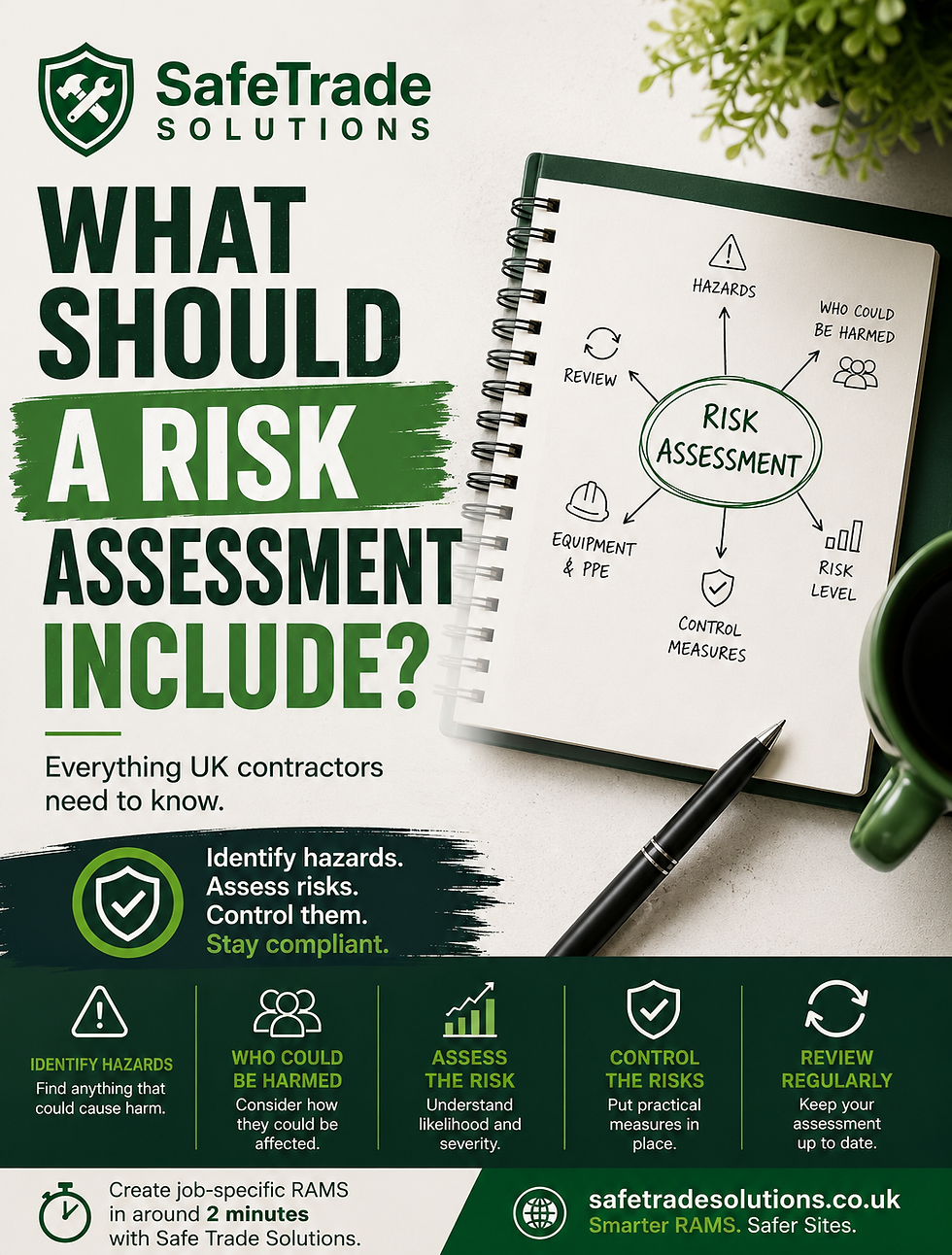
A suitable risk assessment should identify the hazards associated with the work, who could be harmed and how, the level of risk and the measures needed to control those risks.
Most importantly, it should reflect the actual work being carried out.
A good risk assessment isn't about creating as much paperwork as possible. It should help you identify significant risks before work begins and clearly explain how those risks will be controlled.
---
What Should Be Included in a Risk Assessment?
A good risk assessment will normally cover:
• The hazards associated with the work
• Who could be harmed and how
• The level of risk
• Existing control measures
• Any additional controls required
• Relevant equipment and PPE
• When the assessment needs to be reviewed
Let's look at what each of these actually means in practice.
1. Identify the Hazards
The first step is identifying anything associated with the work that has the potential to cause harm.
For construction and maintenance work, this could include working at height, electricity, moving vehicles, power tools, hazardous substances, manual handling, noise, dust or falling objects.
The hazards should come from the actual job rather than a standard list.
For example, a risk assessment for installing electrical sockets should look very different from one for repairing a roof.
2. Identify Who Could Be Harmed and How
Next, consider who could be affected by the work.
This could include employees, contractors, other trades, clients, visitors or members of the public.
It's also important to consider how they could be harmed.
For example, rather than simply listing "members of the public", consider whether they could enter the work area, come into contact with equipment or be struck by tools or materials.
This helps you identify controls that address the actual risk.
3. Evaluate the Level of Risk
You then need to consider how likely an incident is to occur and how serious the consequences could be.
Many businesses use a risk matrix that combines:
Likelihood – How likely is the incident to happen?
Severity – How serious could the consequences be?
This helps categorise risks as low, medium or high and identify which hazards require the most attention.
The purpose isn't simply to create a number or colour on a document. The rating should help you decide whether the existing controls are sufficient.
4. Put Suitable Control Measures in Place
Once you've identified the risks, you need to decide how they will be controlled.
Where possible, you should follow the hierarchy of controls. This means considering whether the hazard can be eliminated or reduced before relying on procedures or Personal Protective Equipment (PPE).
For example, if there is a risk of falling from height, simply writing "wear PPE" isn't enough.
You may need to consider whether the work can be completed from ground level, what access equipment is required, how the work area will be controlled and what fall-prevention measures are needed.
Good control measures should be practical, specific and relevant to the job.
5. Consider the Equipment and PPE
The tools and equipment being used can introduce additional hazards.
Power tools, ladders, access equipment, lifting equipment, machinery and electrical testing equipment can all change the risks associated with a job.
PPE should also be selected based on the hazards identified.
Depending on the task, this might include safety footwear, gloves, eye protection, hearing protection, respiratory protection, safety helmets or protective clothing.
Not every job needs every item of PPE.
If PPE appears on the risk assessment, there should be a genuine reason for it.
6. Make the Risk Assessment Job-Specific
This is one of the most important parts of creating a good risk assessment.
Two contractors could be carrying out similar work but face completely different risks because of the equipment, location or working environment.
Before completing the assessment, consider:
What work is actually being carried out?
Where is it taking place?
What equipment will be used?
Who could be affected?
What are the significant hazards?
What controls are actually required?
A generic risk assessment may look professional, but if it doesn't reflect the job, important hazards can easily be missed.
7. Review the Risk Assessment
A risk assessment shouldn't simply be created and forgotten.
It should be reviewed when there is reason to believe it may no longer be valid or when there has been a significant change to the work.
For example, a review may be needed if the work changes, different equipment is introduced, site conditions change, new hazards are identified or an incident highlights a problem with the existing controls.
The assessment should continue to reflect the work actually being carried out.
What Makes a Good Risk Assessment?
A good risk assessment doesn't need to be unnecessarily complicated.
It should be:
• Specific to the work
• Easy to understand
• Focused on significant hazards
• Clear about how risks will be controlled
• Relevant to the equipment and environment
• Reviewed when circumstances change
The longest risk assessment isn't automatically the best.
A 20-page document containing irrelevant hazards can be less useful than a clear, job-specific assessment that properly identifies and controls the significant risks.
Quality and relevance matter more than the amount of paperwork.
Frequently Asked Questions
What are the main parts of a risk assessment?
A risk assessment should identify the hazards, determine who could be harmed and how, evaluate the risks and establish suitable control measures. It should also identify any further actions required and be reviewed when necessary.
Does a risk assessment need a risk matrix?
There is no requirement to use a particular risk matrix for every risk assessment. However, many businesses use likelihood and severity ratings to help assess and prioritise risks consistently.
Does PPE need to be included in a risk assessment?
Where PPE is required as a control measure, it should be identified. The PPE selected should be appropriate to the actual hazards rather than simply copied from a generic list.
Do I need a different risk assessment for every job?
A risk assessment needs to be suitable and sufficient for the work being undertaken. Similar jobs may involve similar hazards, but differences in the task, equipment, people or working environment can introduce different risks.
Who should complete a risk assessment?
The person carrying out the assessment should be competent to identify the hazards associated with the work and determine suitable control measures.
Create Job-Specific Risk Assessments in Around 2 Minutes
Creating a suitable risk assessment doesn't have to mean spending hours editing old documents or working through generic templates.
Safe Trade Solutions allows contractors to create bespoke, fully editable RAMS in around 2 minutes.
Simply enter the details of the work, equipment and specific requirements, and the platform creates a job-specific Risk Assessment and Method Statement based on the information provided.
You can then review and edit the document, add your company branding and download the completed RAMS ready for use.
No generic templates. Just documentation built around the job you're actually doing.
Related Articles
• Are RAMS a Legal Requirement in the UK?
• What Happens If You Don't Have a RAMS Document?
• Who Is Responsible for Creating RAMS Documents?

Comments