
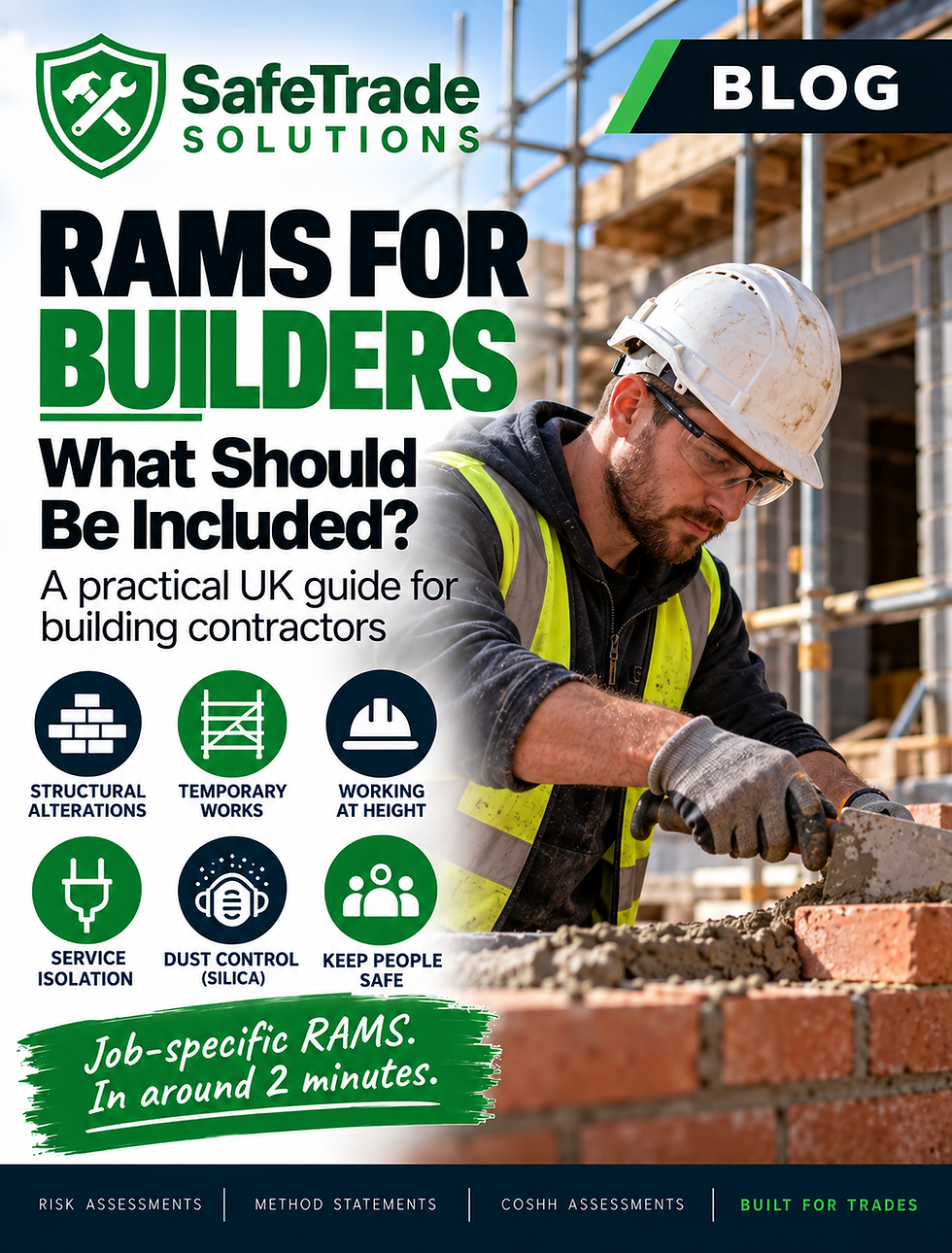
RAMS for Builders: What Should Be Included?
Quick Answer
Builders' RAMS should identify the significant hazards associated with the specific building work and explain how the job will be carried out safely.
They should consider the type of construction work, site conditions, equipment, existing structures, service isolation, working at height, dust exposure, manual handling and anyone who could be affected by the work.
For projects involving demolition or structural alterations, additional consideration must be given to structural stability, temporary works and the sequence of construction activities.
Most importantly, the RAMS should reflect the actual job being undertaken.
A brickwork repair, internal wall removal and house extension may all involve building work, but the hazards and control measures can be very different.
──────────────────────────────────────────────
What Are Builders' RAMS?
RAMS stands for Risk Assessment and Method Statement.
For building work, the Risk Assessment identifies the significant hazards, who could be harmed and the measures needed to control those risks.
The Method Statement explains how the work will be carried out safely and in what sequence.
Together, they provide builders, supervisors, clients and other contractors with a clear plan for managing the work.
──────────────────────────────────────────────
Do Builders Need RAMS?
There isn't a blanket legal requirement for every builder to have a document specifically called "RAMS".
However, employers and those responsible for construction work must assess and manage health and safety risks.
Construction activities are also subject to relevant requirements under the Construction (Design and Management) Regulations 2015.
Clients and principal contractors will commonly require suitable RAMS before certain building activities begin.
For higher-risk activities, such as demolition and structural alterations, the planning and documentation requirements may be more extensive.
──────────────────────────────────────────────
What Should Builders' RAMS Include?
The exact content depends on the project, but builders' RAMS may need to consider:
• Site preparation and access
• Existing structures and structural stability
• Demolition and structural alterations
• Temporary works and supports
• Working at height
• Falling materials and objects
• Excavations and ground conditions
• Existing underground and overhead services
• Electrical and other service isolation
• Construction dust and silica exposure
• Manual handling
• Plant, machinery and power tools
• Lifting operations
• Hazardous substances and COSHH
• Noise and vibration
• Other contractors and members of the public
• Suitable PPE
• Emergency arrangements
Not every hazard belongs in every building RAMS document.
The hazards and controls should be selected because they are relevant to the actual work.
──────────────────────────────────────────────
Demolition and Structural Alterations
Demolition and structural alterations can introduce significant risks, particularly where existing walls, floors, beams or other structural elements are being removed or modified.
Before work begins, the stability of the structure and the potential consequences of the planned alterations must be considered.
Depending on the work, this could include:
• Identifying load-bearing elements
• Assessing structural stability
• Obtaining appropriate structural information
• Planning the sequence of demolition or alteration
• Identifying temporary support requirements
• Preventing uncontrolled collapse
• Establishing suitable exclusion zones
• Protecting adjoining structures
Where required, structural designs and temporary works arrangements should be developed and checked by competent people.
RAMS should reflect these arrangements rather than attempting to replace structural engineering information.
For demolition, dismantling or structural alteration, the arrangements must be recorded in writing before the work begins.
──────────────────────────────────────────────
Temporary Works
Temporary works may be required to support a structure or provide a safe working arrangement during construction.
Examples can include:
• Temporary propping
• Shoring
• Formwork
• Excavation supports
• Temporary working platforms
• Structural support during wall removal
The RAMS should identify relevant temporary works and explain how they fit into the planned sequence of work.
Where temporary works require design, inspection or formal authorisation, those arrangements should be established before the relevant activity begins.
Simply stating "install suitable supports" may not provide enough information for the work to proceed safely.
──────────────────────────────────────────────
Working at Height
Building work frequently involves activities above ground level.
This might include brickwork, roof alterations, external repairs, installation work or accessing elevated areas.
The RAMS should consider:
• How the work area will be accessed
• Whether work at height can be avoided
• Suitable scaffolding or working platforms
• Edge protection
• Falling materials
• Safe movement of tools and materials
• Weather conditions
• Emergency and rescue arrangements
The selected controls should reflect the actual work and location.
Where work at height cannot be avoided, suitable measures should prioritise preventing falls rather than relying solely on personal protective equipment.
──────────────────────────────────────────────
Existing Services and Isolation
Building work can involve drilling, cutting, excavation or demolition around existing services.
These may include:
• Electrical cables
• Gas pipework
• Water supplies
• Drainage systems
• Underground services
• Other building services
The RAMS should identify relevant services and explain how they will be located, protected or isolated where necessary.
Simply writing "check for services" is not always sufficient.
Where isolation is required, the planned arrangements should identify the relevant supply, appropriate isolation method and precautions against unintended reinstatement.
Specialist isolation or disconnection work must be undertaken by appropriately competent and authorised people.
──────────────────────────────────────────────
Construction Dust and Silica
Building activities such as cutting bricks, chasing walls, drilling concrete and removing mortar can generate hazardous dust.
Some construction materials contain crystalline silica, which can create serious health risks when respirable dust is inhaled.
The RAMS should consider:
• The materials being worked on
• The tools and cutting methods being used
• Dust extraction or suppression
• Exposure of nearby workers
• Suitable respiratory protective equipment where required
• Cleaning and waste removal methods
Dust exposure should be controlled at source wherever reasonably practicable.
Simply issuing a dust mask should not automatically be treated as an adequate control.
──────────────────────────────────────────────
Manual Handling and Lifting
Builders regularly move heavy or awkward materials.
These can include:
• Bricks and blocks
• Cement and aggregates
• Timber
• Steel beams
• Plasterboard
• Doors and windows
• Building equipment
The RAMS should consider how materials will be delivered, stored, moved and positioned.
Where possible, mechanical handling equipment should be considered to reduce unnecessary manual lifting.
The controls should reflect the actual weight, dimensions, access restrictions and working environment.
──────────────────────────────────────────────
Plant, Machinery and Power Tools
Building projects can involve a wide range of plant and equipment.
Depending on the job, this might include:
• Excavators
• Dumpers
• Telehandlers
• Disc cutters
• Breakers
• Drills
• Mixers
• Lifting equipment
The RAMS should identify equipment relevant to the work and consider the hazards associated with its use.
These could include moving machinery, contact with rotating parts, noise, vibration, dust and interaction with pedestrians.
Equipment should only be operated by people with the necessary competence and authorisation.
──────────────────────────────────────────────
Need RAMS for Your Next Building Project?
Create job-specific, fully editable RAMS in around 2 minutes with Safe Trade Solutions.
Enter the details of your building work, equipment and specific requirements.
Review and edit your generated Risk Assessment and Method Statement, add your company branding and download when ready.
Create RAMS in minutes — not hours.
──────────────────────────────────────────────
Hazardous Substances and COSHH
Building contractors may use or encounter hazardous substances during construction activities.
Examples include:
• Cement and mortar
• Adhesives and sealants
• Paints and coatings
• Cleaning chemicals
• Solvents
• Dust generated during construction
The risks depend on the substance, how it is used and the potential exposure.
Where required, suitable COSHH assessments should identify the hazards and appropriate control measures.
The RAMS should reflect relevant controls rather than simply listing "COSHH" as a hazard.
──────────────────────────────────────────────
Protecting Other Contractors and the Public
Building work can create risks beyond the immediate work area.
Depending on the location, this could affect:
• Other trades
• Site employees
• Building occupants
• Visitors
• Neighbouring properties
• Members of the public
Suitable controls may include exclusion zones, physical barriers, designated pedestrian routes, controlled deliveries and restricting access to hazardous work areas.
The arrangements should reflect the site and the activities taking place.
──────────────────────────────────────────────
What Should a Building Method Statement Explain?
The Method Statement should clearly explain how the planned building work will be carried out.
Depending on the project, this could include:
• Arrival and site preparation
• Site access and welfare arrangements
• Establishing the work area
• Identifying existing services
• Isolating relevant services
• Delivery and storage of materials
• Installation of temporary works where required
• Establishing safe access equipment
• Demolition or removal of existing materials
• Excavation or ground preparation
• Structural alterations
• Construction and installation activities
• Use of plant and equipment
• Inspection and testing where applicable
• Removal of temporary works when authorised
• Waste removal
• Final checks
• Leaving the work area safe
The sequence should reflect the actual construction activity.
For complex or higher-risk work, additional detail may be required to explain the planned safe system of work.
──────────────────────────────────────────────
Should Builders' RAMS Be Site-Specific?
Yes.
Consider two builders carrying out wall removal work.
One might be removing a non-load-bearing partition in an empty property.
The other could be removing a load-bearing wall inside an occupied commercial building.
Although both jobs could be described as "wall removal", the hazards and controls would be significantly different.
The second project may require structural engineering input, designed temporary supports, service isolation and additional arrangements to protect building occupants.
That's why changing the client name and date on an old RAMS document isn't the same as assessing a new building project.
──────────────────────────────────────────────
Can You Use the Same Building RAMS for Every Job?
Previous RAMS may provide useful information, but they shouldn't simply be reused without checking whether they remain suitable.
Before starting a new building project, consider:
• What construction work is being carried out?
• Are structural alterations involved?
• Will temporary works be required?
• What existing services are present?
• What equipment and machinery will be used?
• Will the work involve excavation or work at height?
• What hazardous substances or dust could be generated?
• Who could be affected by the work?
• What are the significant hazards?
• What controls will actually be implemented?
If the work, equipment or site conditions change, the RAMS may need to be reviewed and updated.
──────────────────────────────────────────────
Frequently Asked Questions
Do builders need a Risk Assessment?
Construction activities can expose workers and others to significant hazards. Those risks must be suitably assessed and controlled.
Do builders need a Method Statement?
Method Statements are commonly used to plan and communicate construction activities, particularly higher-risk work. They may also be required by clients or principal contractors. Certain activities, including demolition and structural alterations, have specific written planning requirements.
Should demolition be included in builders' RAMS?
Where demolition forms part of the work, the associated hazards, structural considerations and planned controls must be properly addressed.
Do building RAMS need to include service isolation?
Where electrical, gas, water or other services could create risks during the work, suitable identification, protection or isolation arrangements should be included.
Should construction dust be included?
Where activities generate hazardous dust, the exposure risks and relevant controls should be assessed. This is particularly important when cutting or drilling silica-containing materials.
Can builders use generic RAMS?
Previous documents may provide useful information, but RAMS must remain suitable for the actual work, site conditions, equipment and hazards.
──────────────────────────────────────────────
Create Job-Specific Building RAMS in Around 2 Minutes
Safe Trade Solutions helps building contractors create bespoke, fully editable RAMS in around 2 minutes.
Simply:
1. Enter the details of your building work, equipment, hazards and specific requirements.
2. Generate a job-specific Risk Assessment and Method Statement.
3. Review and edit the documents where needed.
4. Add your company branding.
5. Download your completed RAMS document.
Your company details and logo can be saved, helping make future documents quicker to create.
Customer details can also be saved and selected when needed, reducing repeated data entry.
You can also add job photos to provide additional information when creating your RAMS.
If the job changes, update your RAMS to reflect the work actually being carried out.
No generic templates. Just documentation built around the job you're actually doing.
──────────────────────────────────────────────
Related Articles
• RAMS for Plumbers: What Should Be Included?
• RAMS for Electricians: What Should Be Included?
• RAMS for Roofing: What Should Be Included?
• RAMS for Scaffolding: What Should Be Included?
──────────────────────────────────────────────


Comments