
Scaffolding RAMS: What Should Be Included?
Quick Answer
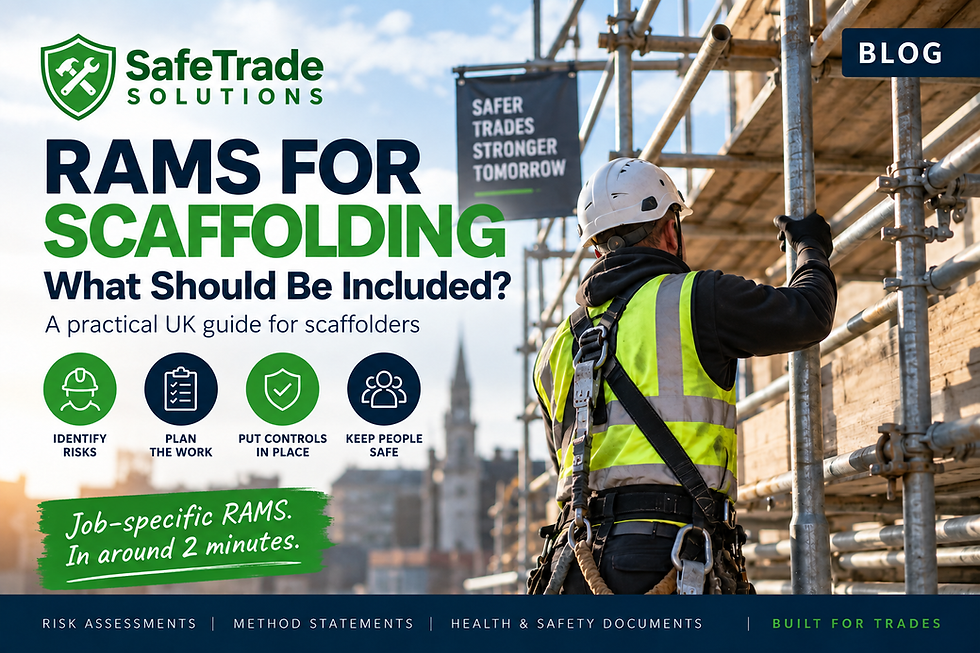
Scaffolding RAMS should explain how the specific scaffolding work will be carried out safely and identify the significant risks associated with the job.
They should consider the scaffold being erected, altered or dismantled, the site conditions, access, equipment, people who could be affected and the controls needed to manage the work safely.
A good scaffolding RAMS document shouldn't simply say "erect scaffold safely".
It should reflect what is actually happening on that particular job.
What Are Scaffolding RAMS?
RAMS stands for Risk Assessment and Method Statement.
For scaffolding work, the Risk Assessment identifies the significant hazards, who could be harmed and the controls required to reduce the risks.
The Method Statement explains how the scaffolding work will be carried out safely and in what sequence.
Together, they provide workers, contractors and clients with a clear plan for managing the work.
Do Scaffolders Need RAMS?
There isn't a blanket legal requirement for every contractor to possess a document specifically called "RAMS".
However, employers and those responsible for work must assess and manage health and safety risks.
Scaffolding also involves work at height, which must be properly planned, appropriately supervised and carried out by competent people.
In practice, principal contractors, construction companies and clients will commonly require suitable RAMS before scaffolding work begins.
What Should Scaffolding RAMS Include?
The exact content will depend on the job, but scaffolding RAMS will normally need to consider:
• The type and purpose of the scaffold
• The location and surrounding work area
• Ground and foundation conditions
• Safe erection and dismantling
• Work at height
• Falling materials and objects
• Scaffold stability and ties
• Safe access and egress
• Manual handling
• Delivery and movement of scaffold materials
• Nearby workers, other trades and members of the public
• Relevant plant, tools and equipment
• Suitable PPE
• Emergency arrangements
The important point is that these should be considered against the actual job rather than copied automatically into every document.
Work at Height
Falls from height are one of the most significant hazards associated with scaffolding.
The method of work should therefore explain how the risk of falls will be controlled during erection, alteration and dismantling.
This could include the sequence of erection, collective fall protection, safe working platforms and, where required, suitable personal fall protection.
The controls should match the scaffold and the way the work will actually be undertaken.
Ground Conditions and Scaffold Stability
A scaffold needs a suitable foundation capable of supporting the scaffold and the loads placed upon it.
Conditions can vary considerably between sites.
Soft ground, slopes, underground voids, drains and other site conditions may affect how the scaffold can be safely erected.
The RAMS should therefore consider the actual location rather than assuming every scaffold will be erected on the same surface.
Stability, bracing and tying arrangements should also be considered where relevant to the scaffold design and work being undertaken.
Falling Materials and Public Protection
Scaffolding work doesn't only create risks for the scaffolders.
People working below, other contractors, visitors and members of the public may also be affected.
Suitable controls could include:
• Exclusion zones
• Segregated working areas
• Controlled material handling
• Toe boards or other suitable protection
• Safe storage of materials
• Restrictions on access beneath the work
The controls required will depend heavily on the location.
A scaffold erected on an occupied construction site may require different controls from one being erected alongside a public pavement.
Manual Handling
Scaffold tubes, boards and fittings can involve significant manual handling.
The RAMS should consider how materials will be delivered, unloaded, moved around the site and transferred to the required working level.
Where mechanical assistance or particular handling methods are planned, these should be reflected in the method of work.
Simply listing "manual handling" as a hazard isn't enough.
The document should explain how the risk will actually be managed.
Access and Egress
Safe access should be considered throughout the work.
This includes access for the scaffolders during erection and dismantling as well as the arrangements for people who will eventually use the completed scaffold.
Access routes should be appropriate for the scaffold, maintained as work progresses and kept clear of unnecessary obstructions.
Scaffold Inspections
Scaffold inspections are separate from the RAMS themselves, but they are an important part of managing scaffolding safely.
Where the relevant legal requirements apply, scaffolds must be inspected by a competent person at the required intervals and following circumstances that could affect their safety.
The RAMS shouldn't be used as a substitute for the required scaffold inspection regime.
Should Scaffolding RAMS Be Site-Specific?
Yes.
Two scaffolding jobs may look similar but have very different risks.
For example, one scaffold might be erected on a quiet private site while another is erected next to a busy public footpath.
The scaffold itself could be similar, but the risks and controls may be completely different.
Other factors such as ground conditions, overhead services, neighbouring properties, vehicle movements, restricted access and interaction with other contractors can also change what needs to be considered.
This is why simply changing the client's name and date on an old RAMS document isn't good practice.
Need RAMS for Your Next Scaffolding Job?
Create job-specific, fully editable RAMS in around 2 minutes with Safe Trade Solutions.
Enter the details of the work, equipment and specific requirements, review and edit your documents, add your company branding and download when you're ready.
Create RAMS in minutes — not hours.
What Should the Scaffolding Method Statement Explain?
The Method Statement should give the people carrying out the work a clear understanding of how the job is intended to proceed.
Depending on the project, this may cover:
• Arrival and site preparation
• Delivery and unloading of materials
• Establishing the work area
• Checking ground conditions
• Erection sequence
• Installation of access and fall protection
• Bracing and tying arrangements
• Alterations where required
• Dismantling sequence
• Removal of materials
• Leaving the work area safe
The level of detail should be proportionate to the complexity and risks of the work.
Who Should Prepare Scaffolding RAMS?
RAMS should be prepared with sufficient knowledge of the work, hazards, equipment and site conditions.
The person preparing or approving them needs enough information to ensure the document genuinely reflects the planned work.
This is particularly important with scaffolding because the safe system of work may depend on the scaffold configuration, location and erection method.
Can You Use the Same Scaffolding RAMS for Every Job?
Not without checking that it remains suitable for the work.
Previous RAMS may provide useful information, but they shouldn't simply be reused without considering the new project.
Ask:
What scaffold are we erecting?
Where are we erecting it?
What are the site conditions?
Who could be affected?
What equipment will be used?
What are the significant hazards?
How will those hazards actually be controlled?
If those answers change, the RAMS may need to change too.
Frequently Asked Questions
Do scaffolders need a Risk Assessment?
Where work activities create health and safety risks, those risks need to be suitably assessed and controlled. Scaffolding work presents several potentially significant hazards, particularly work at height.
Does a scaffolding RAMS need a Method Statement?
Method Statements are commonly used for scaffolding because they provide a practical way of communicating how the work will be carried out safely. They may also be required by the client or principal contractor.
Should work at height be included?
Yes. Work at height is one of the principal risks associated with scaffold erection, alteration and dismantling and should be properly considered.
Do scaffolding RAMS need to include PPE?
Where PPE is required as part of the control measures, it should be identified. PPE should be selected according to the actual hazards rather than automatically adding every available type.
Do RAMS replace scaffold inspections?
No. RAMS and scaffold inspections serve different purposes. Having a RAMS document does not remove the requirement for any inspections required for the scaffold.
Create Job-Specific Scaffolding RAMS in Around 2 Minutes
Safe Trade Solutions helps scaffolding contractors create bespoke, fully editable RAMS in around 2 minutes.
Enter the details of the scaffolding work, equipment, hazards and specific requirements.
Safe Trade Solutions then creates a job-specific Risk Assessment and Method Statement based around the information provided.
Review it.
Edit it.
Add your company branding.
Download it.
And if the job changes, update the RAMS to reflect the work being carried out.
No generic templates.
Just documentation built around the job you're actually doing.
Related Articles
Are RAMS a Legal Requirement in the UK?
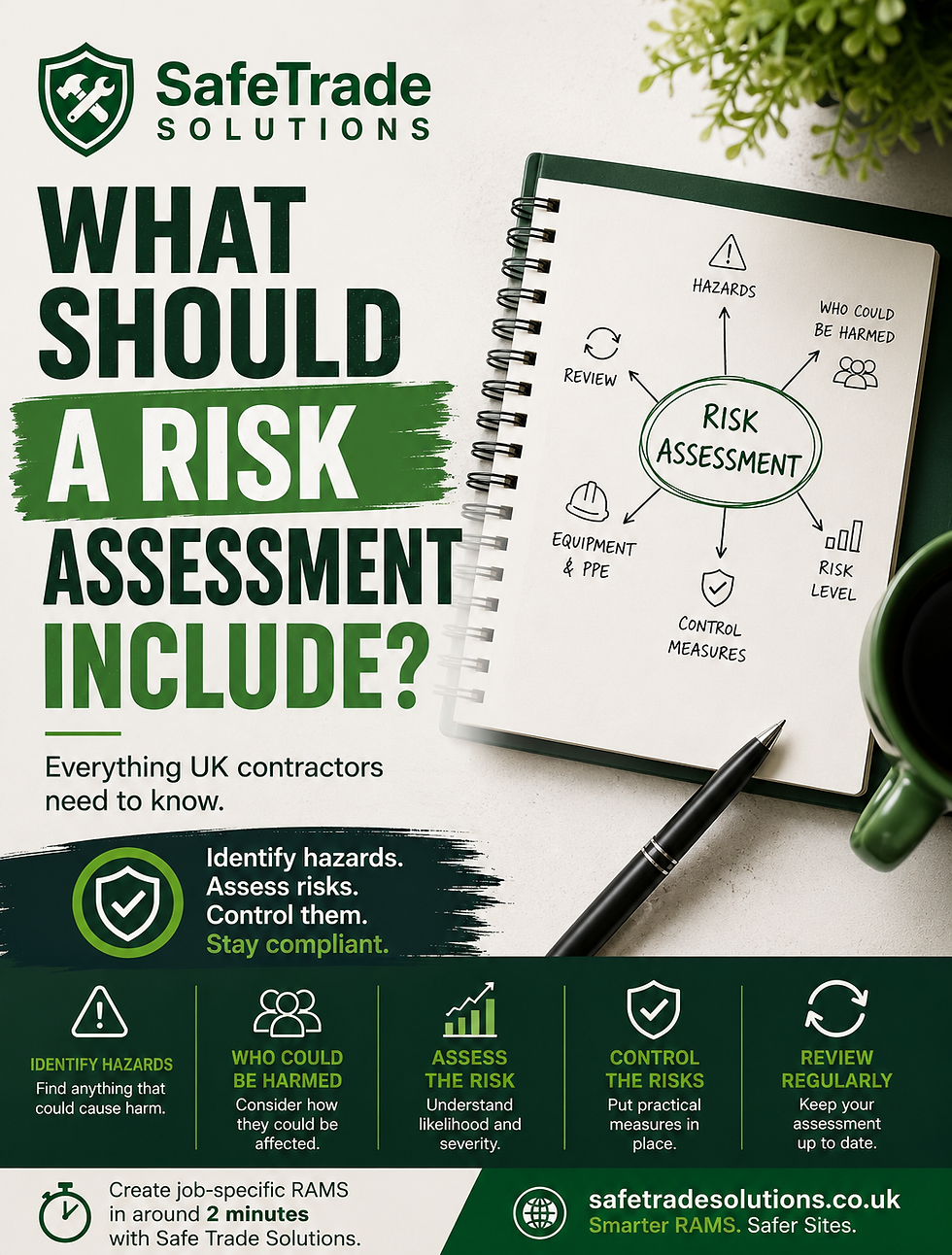
What Should a Risk Assessment Include?
Can I Use the Same RAMS Document for Every Job?
What Happens If You Don't Have a RAMS Document?

Comments